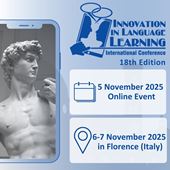
Innovation in Language Learning


Soft Skills and Teacher Professional Development in Moroccan Higher Education: Rethinking Pedagogical Training in the Digital Era
Farida Mokhtari, Sidi Mohammed Ben Abdellah University, Fès (Morocco)
Abstract
In recent years, Moroccan higher education has undergone significant transformation driven by digitalization, globalization, and changing labor market expectations. Within this evolving context, soft skills have gained increasing importance as a key component of effective teaching practice, complementing disciplinary knowledge and reshaping the profile of university educators. This study investigates the role of soft skills in teacher professional development, with particular attention to how pedagogical training programs in Morocco are responding to the demands of the digital era. Rather than limiting teacher development to technical mastery or content delivery, this research adopts a broader perspective that highlights communication, adaptability, emotional intelligence, collaboration, and critical thinking as essential competencies for contemporary educators. It further examines how digital tools and online learning environments are transforming classroom interaction and requiring new forms of pedagogical flexibility and engagement. Methodologically, the study is based on a critical review of recent scholarly literature on teacher training, competence-based education, and digital pedagogy, supported by an analytical reflection on current practices in Moroccan universities. The findings indicate that although institutional reforms have increasingly integrated digital literacy into teacher training, the systematic and explicit incorporation of soft skills remains uneven and underdeveloped. The study argues for a rethinking of pedagogical training frameworks that move beyond traditional content-centered approaches toward more integrated models that combine digital competencies with soft skills development. It concludes that strengthening these competencies is essential not only for improving teaching quality, but also for enhancing student engagement and ensuring the adaptability of higher education institutions in a rapidly changing academic landscape.
Keywords: Soft skills; teacher professional development; Moroccan higher education; digital pedagogy; educational innovation; 21st-century skills.
REFERENCES
1. UNESCO. (2023). Global Education Monitoring Report: Technology in education – A tool on whose terms? Paris: UNESCO Publishing.
2. OECD. (2021). 21st-Century Readers: Developing literacy skills in a digital world. Paris: OECD Publishing.
3. World Bank. (2020). Higher Education in Morocco: Reform and Development Perspectives. Washington, DC: World Bank.
4. Redecker, C. (2017). European Framework for the Digital Competence of Educators (DigCompEdu). Luxembourg: Publications Office of the European Union.
5. Boud, D., & Hager, P. (2012). Re-thinking continuing professional development through changing metaphors and location in professional practice. Studies in Continuing Education, 34(1), 17–30.