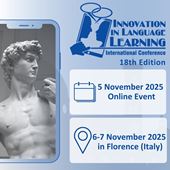
Innovation in Language Learning


Language Learning as Cultural Diplomacy in the AI Era: Developing Global Citizens Through Multilingual Communication
Beatrice de Salles, University of San Francisco School of Management, San Francisco (United States)
Abstract
Artificial intelligence is transforming language education, expanding opportunities for multilingual learning while redefining the competencies required of future global professionals. As AI-powered translation, interpretation, and language learning technologies become increasingly sophisticated, the role of language education extends beyond linguistic proficiency toward cultivating intercultural competence, ethical communication, and global citizenship.
This paper argues that language learning should be understood not only as an academic discipline but also as a strategic instrument of cultural diplomacy that promotes international dialogue, mutual understanding, and peaceful cooperation. While AI offers unprecedented opportunities to democratize language access, meaningful communication continues to depend on uniquely human qualities such as empathy, cultural awareness, critical thinking, and relationship building.
Drawing upon professional experience in international relations, multilingual communication, journalism, interpretation, higher education, and global leadership development, this presentation introduces an interdisciplinary framework integrating language acquisition, cultural intelligence, communication ethics, AI literacy, and experiential international learning. Through examples from educational initiatives, cross-cultural collaborations, and leadership programs spanning numerous countries, the paper demonstrates how multilingual education can prepare students to address complex global challenges while strengthening international partnerships.
The presentation concludes with practical recommendations for educators, universities, policymakers, and language professionals seeking to redesign language curricula for the AI era. It proposes that the future of language education lies not merely in teaching additional languages, but in preparing learners to become culturally intelligent global citizens capable of building bridges across cultures, advancing inclusive dialogue, and contributing to sustainable peace through effective multilingual communication.
Keywords: Artificial Intelligence; Language Learning; Cultural Diplomacy; Intercultural Communication; Multilingual Education; Global Citizenship; Cultural Intelligence; Translation and Interpretation; Higher Education; International Relations.