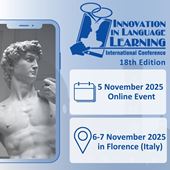
Innovation in Language Learning


Language Teachers in the Age of Generative AI: A Contextualised Review of International Evidence and Implications for Teacher Education in Malta
Joseph Vancell, University of Malta (Malta)
Abstract
The rapid diffusion of generative artificial intelligence (GenAI) tools, themselves language models, has particular significance for language education. This contextualised literature review examines recent international research on the use of GenAI by initial teachers (including [1] and [2]). It then considers the relevance of these findings to the Master of Teaching and Learning (MTL) programme at the Faculty of Education, University of Malta. This review is part of a comprehensive empirical study with students enrolled in the MTL programme. Drawing on studies framed by the Technological Pedagogical Content Knowledge (TPACK) model (including [3] and [4]), teacher professional identity theory (including [5] and [6]), and Technology Acceptance Model (TAM) research (including [7] and [8]), the review identifies four recurring themes: professional development and pedagogical enhancement; perceptions, acceptance and identity negotiation; practical classroom applications such as lesson planning and feedback; and ethical and equity concerns. The paper then considers the implications of these themes for MTL teaching, supervision, and future research, arguing that Malta's ambitious national digital education strategy [9] has outpaced the local empirical evidence base on how trainee language teachers actually engage with GenAI, and that the MTL programme is well placed to help close this gap. The paper argues that the post-graduate programme is well positioned to address this gap through TPACK-informed, TAM-conscious, identity-sensitive, critically reflective and equity-aware professional development.
Keywords: generative artificial intelligence (GenAI); Initial Teacher Education (ITE) students; language education; TPACK; Malta; MTL
Selected References
[1] Lee, S., Choe, H., Zou, D., & Jeon, J. (2026). Generative AI (GenAI) in the language classroom: A systematic review. Interactive Learning Environments, 34(1), 335–359. https://doi.org/10.1080/10494820.2025.2498537
[2] Kohnke, L., Moorhouse, B. L., & Zou, D. (2023). ChatGPT for Language Teaching and Learning. RELC Journal, 54(2), 537–550. https://doi.org/10.1177/00336882231162868
[3] Mishra, P., Warr, M., & Islam, R. (2023). TPACK in the age of ChatGPT and Generative AI. Journal of Digital Learning in Teacher Education, 39(4), 235–251. https://doi-org.ejournals.um.edu.mt/10.1080/21532974.2023.2247480
[4] Ning, Y., Zhang, C., Xu, B., Zhou, Y., & Wijaya, T. T. (2024). Teachers’ AI-TPACK: Exploring the Relationship between Knowledge Elements. Sustainability, 16(3), Article 978. https://doi.org/10.3390/su16030978
[5] Akkerman, S. F., & Meijer, P. C. (2011). A dialogical approach to conceptualizing teacher identity. Teaching and Teacher Education, 27(2), 308–319. https://doi.org/10.1016/j.tate.2010.08.013
[6] Beijaard, D., Meijer, P. C., & Verloop, N. (2004). Reconsidering research on teachers’ professional identity. Teaching and Teacher Education, 20(2), 107–128. https://doi.org/10.1016/j.tate.2003.07.001
[7] Jalil, F. (2026) Becoming with the algorithm: A posthumanist narrative of EFL teacher identity in the age of AI. Science Direct. Elsevier. https://doi.org/10.1016/j.system.2026.104069.
[8] Barnes, M., & Tour, E. (2026). Teachers’ use of generative AI: a ‘dirty little secret’? Language and Education, 40(1), 24–39. https://doi.org/10.1080/09500782.2025.2485935
[7] Ministry for Education, Sport, Youth, Research and Innovation. (2024). Digital education strategy 2024–2030. Government of Malta. https://education.gov.mt/wp-content/uploads/2024/04/Digital-Education-Strategy-Consultation-Document-ENG-Version-3.pdf