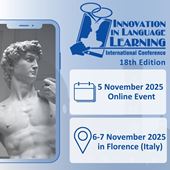
Innovation in Language Learning


Digital Competence and Innovation in Language Teaching and Learning: A pre-GenAI Perspective
Nancy Mezzio, Justus Liebig University of Giessen (Germany)
Abstract
Artificial Intelligence (AI), and more recently generative AI (GenAI) have profoundly transformed the digital landscape of language education (Ludwig 2022; Liang et al. 2023). New tools have emerged rapidly, and future language teachers are increasingly expected not only to be familiar with and use digital technologies, but also to be able to critically evaluate and integrate them into their teaching with pedagogical awareness (Redecker 2017). However, the growing availability of digital tools does not necessarily imply a corresponding ability to translate their potential into meaningful teaching practices.
What if some of the challenges currently associated with AI-supported language teaching were not new at all? This proposal takes a step back to 2023, shortly before generative AI became a widespread feature of educational discourse and practice. It draws on data from an empirical study aimed at exploring the digital competences of pre-service teachers of modern foreign languages (English, French, Spanish) for secondary schools in Germany, as well as their perceived abilities, expectations and needs regarding the integration of digital media into teacher education. The results paint an interesting picture, in light of which a broader question emerges: to what extent are the challenges currently associated with generative AI genuinely new, and to what extent do they reflect pre-existing challenges related to digital pedagogical competence? Building on the areas explored in the study, the presentation invites reflection on what ‘digital competence’ (Cosgrove/Cachia 2025) should mean today. It will then move from theory to practice, offering examples of innovative digital language-learning activities based on the integration of films (Henseler et al. 2011), videos and interactive elements (Moreno/Mayer 2007).